How SMB Can Fight Back Ethically to Tolling
The Ethical Alternative to Big-Box Manufacturing and Tolling
Across the country—Phoenix, Oklahoma City, Texas, New Jersey, right down to the smallest private-label facilities—the truth about big-box food manufacturing is becoming impossible to ignore. The industry has spent years refining a model where working capital matters more than human capital, cost is prioritized over quality, and opacity is viewed as an operational advantage.
But here’s the real story:
Small businesses have never had a better opportunity to fight back, take market share, and rebuild consumer trust with models that reward transparency and ethics—not shortcuts and hidden substitutions.
This is not another doom-and-gloom exposé.
This is a blueprint for how SMBs can rise while the large manufacturers collapse under their own weight.
The Big Manufacturer Problem: A System Built on Cost-Cutting and Complexity
Modern food manufacturing has become a complex web of subcontracted labor, temporary agency layers, shell LLCs, and contract kitchens, designed to obscure the true origin of products. Consumers see a friendly brand. Retailers see a glossy pitch deck. But behind the curtain is an operational structure engineered to shield oversight and maximize margin.
In places like Oklahoma City, concerns center on unstable, off-the-books labor routed through subcontractors with little transparency. In Phoenix, facilities rely on decades-old temp agencies and dissolved corporate identities, making accountability nearly impossible. These aren’t isolated issues—they’re the business model.
When human capital becomes invisible, quality becomes negotiable.
On the financial side, the incentives are even more misaligned. Operators focus on:
- inventory cycles
- COGS
- margin preservation
- cash flow timing
- capacity maximization
Very little attention is paid to the humans who produce the food—or the consumers who eat it. Ingredient sourcing is reduced to a cost-per-pound calculation. Recipes shift quietly to cheaper fillers and stabilizers. Packaging says nothing about what changed.
And when something goes wrong, liability is pushed through layers of LLCs until it disappears.
This is the environment that allowed tolling to mutate from a simple capacity-sharing agreement into a profit-extraction weapon.
The Tolling Wildfire: Why the Big Players Love It
Tolling used to mean:
“You use our facility; we charge a fee.”
Now it means:
“We control your ingredients, take your margin, shift the risk, and if something goes wrong—your brand takes the hit.”
Investment groups love this because:
- fees are predictable
- volume is high
- oversight is minimal
- accountability is nonexistent
- ingredient downgrades are hidden
- the consumer never knows
From Phoenix to OKC to Chicago to New Jersey, tolling has become the dominant model for private-label goods and frozen foods. It maximizes output while separating the manufacturer from the consequences.
This model is spreading like wildfire.
But consumers are waking up—and that is exactly where SMBs have the upper hand.
The SMB Advantage: Ethics, Transparency, and True Craft
Small businesses don’t need the web of temp agencies or the multi-layered LLC structures. They don’t have investors demanding margins at any cost. They don’t have to hide behind packaging that tells half the story.
And consumers are desperate for honesty.
When big manufacturers focus solely on working capital, SMBs will continue to win by focusing on human capital:
- the skill of the maker
- the care in the process
- the quality of the ingredients
- the relationship with the local community
- the transparency from raw material to final product
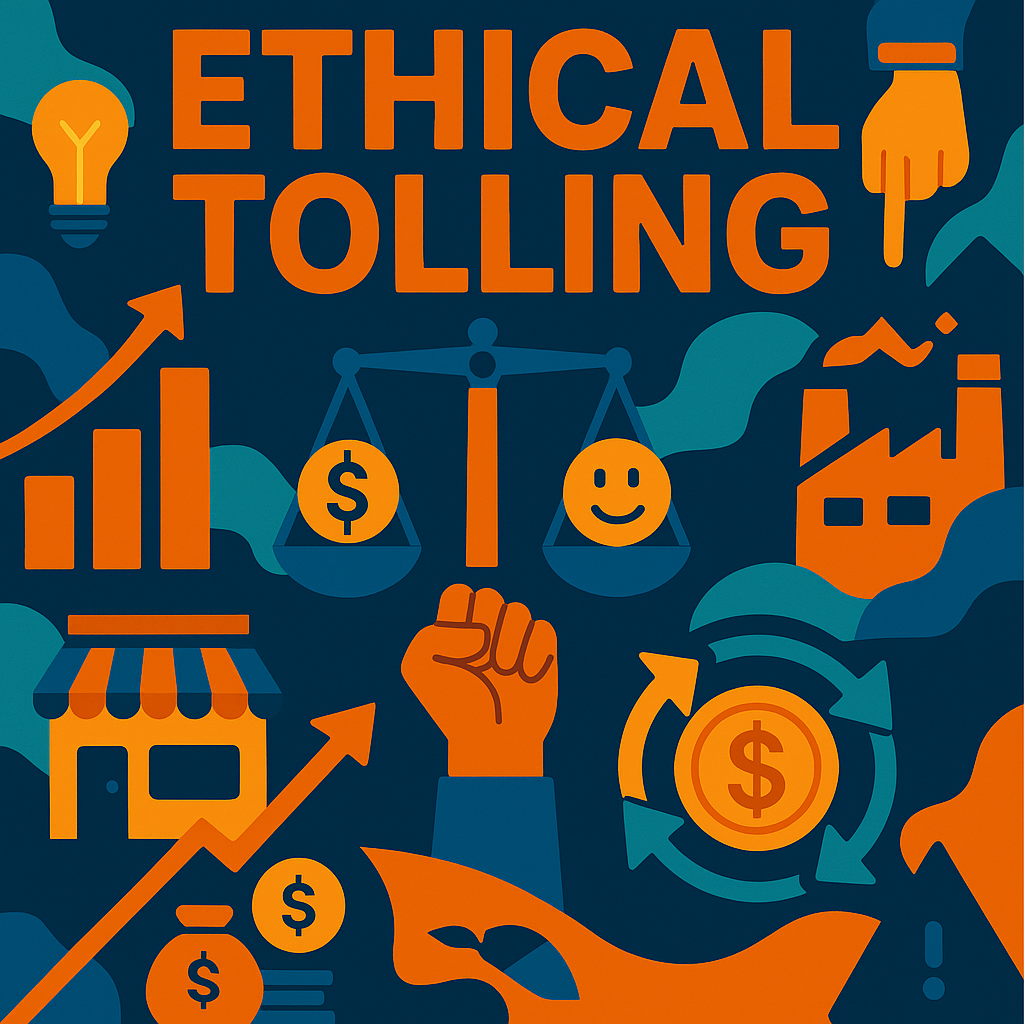
This is where SMBs can flip the script and use an ethical tolling model to compete, stay profitable, and stay small.
The Ethical Tolling Playbook for SMBs
SMBs can use the framework of tolling—shared use of expertise, equipment, and infrastructure—without the greed, secrecy, and degradation of quality.
Here are the strongest SMB strategies:
1. Micro-Tolling / Shared Production Space
Let local producers use your equipment or facility during downtime.
This works for:
- commercial kitchens
- co-packing
- cosmetics labs
- woodworking shops
- print studios
- metalworking stations
You stay small but monetize your fixed costs.
2. Process-as-a-Service (PaaS)
Clients bring raw material, data, designs, or components.
You run the process.
- grain milling
- freeze-drying
- CNC cutting
- 3D printing
- fabric and vinyl printing
- private-label roasting
Zero inventory risk.
Pure processing revenue.
3. AI & Automation Tolling (Ames & Associates)
You become the operational brain for SMBs:
- document intake
- CRM cleanup
- forecasting
- dashboards
- workflow automation
- lead scoring
- reporting
- financial prep packets
Ames & Associates is the ethical tolling facility for data, finance, and operations.
4. Micro Co-Packing / Micro Manufacturing
Offer clean, transparent micro-runs (100–1,000 units):
- bottling
- labeling
- packaging
- compliance help
You give local brands a trustworthy alternative to big-box tolling.
5. Equipment Access Subscriptions
Let creators rent high-cost tools:
- laser engravers
- CNC routers
- industrial sewing machines
- kilns
- dehydrators
- commercial mixers
You own the tools.
They pay the toll.
6. Back-Office Tolling (Ames & Associates)
Provide the core intelligence SMBs can’t afford in-house:
- quoting
- job costing
- budgeting
- payroll prep
- CRM setup
- data reconciliation
- filings and documentation
This is high-margin, low-overhead work.
7. Agriculture Tolling (The local alternative)
Offer farms:
- freeze-drying
- prep and wash lines
- slicing
- storage
- vacuum sealing
- distribution
This is exactly what big manufacturers do—minus the secrecy.
8. Fabrication-on-Demand
People bring designs, parts, or sketches.
You handle:
- cutting
- welding
- assembly
- machining
A literal tolling model for tradespeople.
9. White-Label Expertise (Ames & Associates)
Our skills, your branding.
- FP&A models
- SOPs
- training systems
- tax packet organization
- AI summaries
- client onboarding kits
High-value, scalable.
10. Micro-Distribution Tolling
Serve local makers who can’t afford a 3PL:
- sort
- store
- pick
- deliver locally
Small brands love this.
The Unified Message: SMBs Win When They Stay Human
The packaged food industry may be imploding under its own shortcuts, temp-labor labyrinths, and working-capital obsession. But small businesses don’t have to play that game.
You can stay small, stay ethical, stay transparent, and still stay profitable.
Big manufacturers hide risk.
SMBs build trust.
Big manufacturers chase volume.
SMBs deliver quality.
Big manufacturers degrade ingredients.
SMBs elevate them.
This is how SMBs fight back—and win.
And as the truth continues to surface, the businesses that put ethics before expedience will come out on top.
The future belongs to transparent, resilient, human-first small businesses—not the greedy guys who sacrificed human capital in the name of working capital.
Ready to build ethical, high-integrity systems that outperform big-box manufacturing?
Email claudia@amesandassociates.com or call 866-646-3050 to start your SMB transformation today.